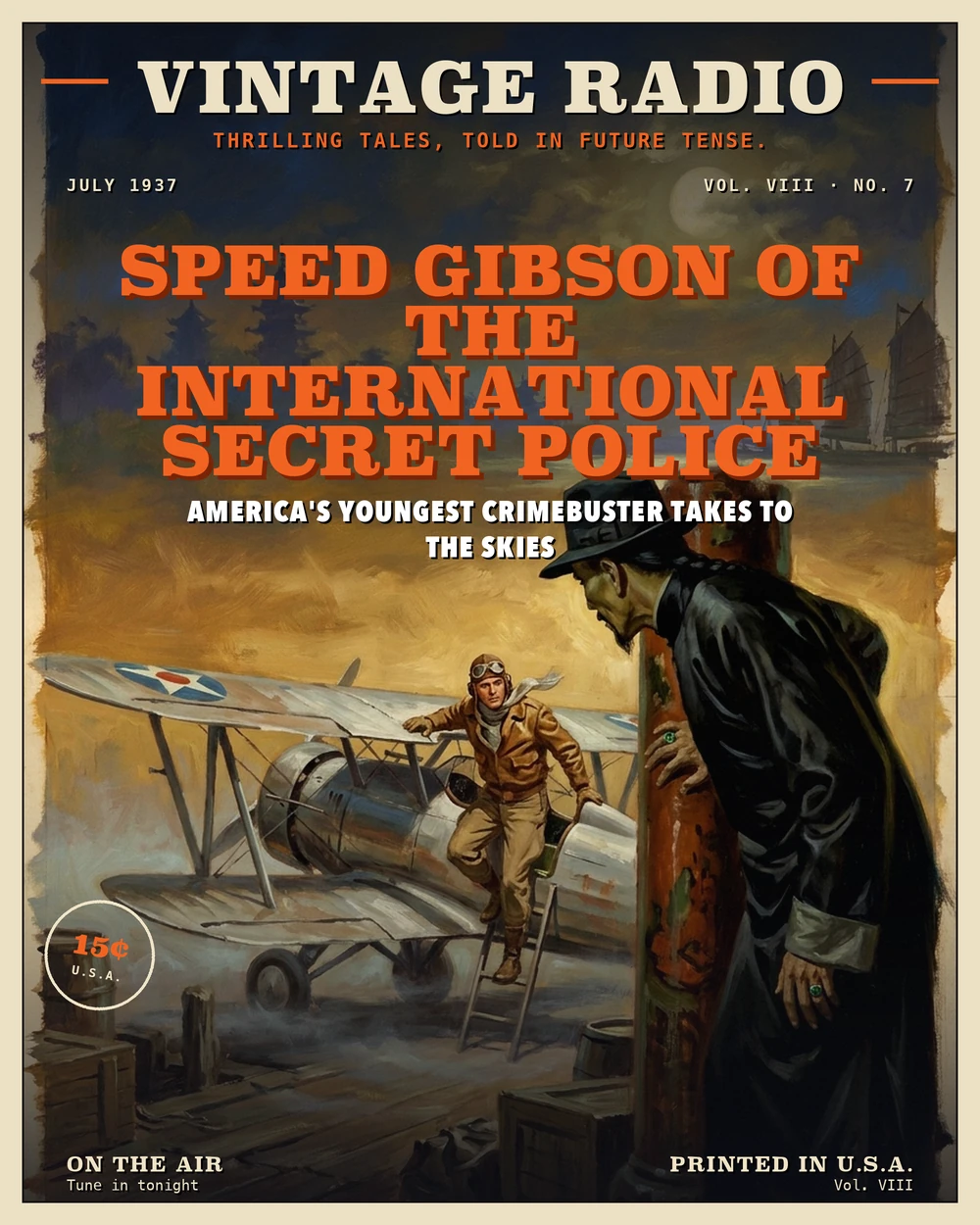
Speed Gibson of the International Secret Police
A Kid, a Clipper, and a Criminal Called the Octopus
What launched one of the more ambitious juvenile adventure serials of the late 1930s was a boy knocking out an intruder with a model airplane. That model — a Martin M-130 China Clipper that Speed was building in his bedroom — is what brings 15-year-old Speed Gibson to the attention of the International Secret Police. From there, the show barely stops moving. Written by Virginia Cooke and distributed as pre-recorded transcriptions to local stations, Speed Gibson of the International Secret Police ran from January 2, 1937, through May 25, 1940, accumulating 178 fifteen-minute chapters across two distinct story arcs. It never aired on a single national network; individual stations picked it up, which was how transcription syndication worked at the time.
The premise is straightforward. Speed, his uncle Clint Barlow — a crack ISP agent — and their semi-comical companion Barney Dunlap pursue a master criminal known only as the Octopus, who commands a ruthless gang with nothing less than the fate of the world at stake. The trio traveled by airship aboard the Flying China Clipper, touching down in Hong Kong by episode three, Wake Island by episode six, and eventually pushing deep into the Orient and Africa. The first 100 episodes are grouped under the title "The Menace of the Octopus"; the remaining 78 follow "Speed Gibson and the Atlantian Syndicate" across the African continent. Altogether, the complete serial runs close to 39 hours of audio.
The opening signature set the mood immediately: the drone of an aircraft engine, then an urgent voice repeating "Ceiling zero! … ceiling zero! … ceiling zero!" — a tight atmospheric hook for young listeners tuning in each week.
The Characters and the Cast
Speed was described in the show's own promotional language as "a typical American boy: interested in short wave radio, aviation and most of all—The International Secret Police." His uncle Clint, played by Howard McNear, provided the seasoned authority that kept the adventure credible. Barney Dunlap — credited to John Gibson — supplied the comic relief, most memorably through his catchphrase "Suffering whangdoodles!" Virginia Cooke also wrote in a recurring female character, Marcia Winfield, a governess to a child named little Jean Kingsley, specifically to give girl listeners someone to follow. Jack Mathers and Victor Rodman rounded out the supporting cast.
The actor who played Speed himself remains uncertain. Elliott Lewis appeared in the cast, and some researchers believe he played the title role, while others place him as Splinters, one of the Octopus's henchmen. Hanley Stafford and Sam Edwards also appeared. The question of exactly who voiced Speed has not been definitively resolved.
The Cast After Speed Gibson
Several performers who worked on this serial went on to significant careers elsewhere. Howard McNear, born in Los Angeles in 1905, had studied at the Oatman School of Theater and worked in stock theater in San Diego before radio. After Speed Gibson he created the role of Doc Charles Adams on CBS Radio's Gunsmoke and appeared frequently on Yours Truly, Johnny Dollar through the 1950s. Television audiences know him best as Floyd the Barber on The Andy Griffith Show, a role he continued even after a 1963 stroke paralyzed the left side of his body — returning at Andy Griffith's personal request. He died in 1969 at 63.
Elliott Lewis, born in New York City in 1917, made his radio debut in 1936 at the age of 18, making this serial one of his earliest credits. CBS Radio publicity eventually dubbed him "Mr. Radio" for his work as writer, producer, director, and actor across more than 1,200 radio productions. He went on to play Frankie Remley on The Phil Harris–Alice Faye Show and took over the directorship of Suspense from William Spier in 1950. He later produced The Lucy Show and worked in television through the 1960s, dying in 1990.
Hanley Stafford, born Alfred John Austin in Hanley, Staffordshire, took his stage name from his birthplace. He immigrated to Canada as a boy, enlisted in a Canadian military platoon at 16, and formed a theatrical group during his World War I convalescence that launched his acting career. Before Speed Gibson he had appeared in syndicated serials including Chandu the Magician, Flash Gordon, Tarzan of the Apes, and The Cinnamon Bear. His greatest fame came playing Lancelot "Daddy" Higgins opposite Fanny Brice on The Baby Snooks Show, beginning in 1938, and as J.C. Dithers on Blondie. He died in 1968. Sam Edwards, another cast member here, later worked on Dragnet and Gunsmoke, among many other programs across a long career.
What the Show Was
Speed Gibson fits within a specific tradition of juvenile aviation-adventure radio serials that also includes The Air Adventures of Jimmie Allen, Captain Midnight, and Hop Harrigan. It's a fine example of what mid-1930s juvenile radio could do with a globe-trotting premise, a capable writer, and a cast that included several performers who would become notably accomplished in the years ahead. All 178 episodes survive intact — a complete run of nearly 39 hours of continuous adventure storytelling, which is a rare thing for a syndicated serial of this era.